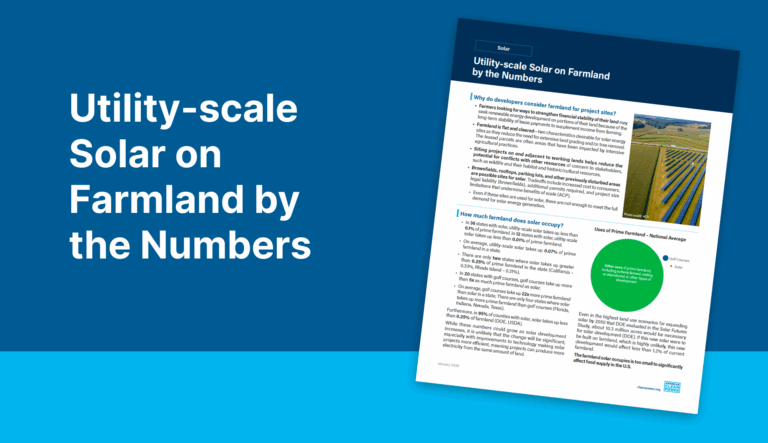
Utility‑scale solar occupies a small share of U.S. prime farmland today—and is projected to remain a minor land use even in aggressive clean‑energy growth scenarios. The data shows solar development can coexist with agricultural production while providing meaningful economic benefits to landowners.
Key Considerations:
Why Farmland Is Sometimes Used for Solar
- Farmers may lease land for solar to create long‑term, stable supplemental income that strengthens farm financial resilience.
- Farmland’s flat, cleared terrain reduces grading and site‑prep costs, making it operationally efficient for solar siting.
Projects sited on or near agricultural land can help minimize conflicts with sensitive resources (e.g., wildlife habitat, cultural sites).
- Brownfields, rooftops, and parking lots are also viable but come with higher costs, size limitations, additional permits, or liability risks, making them insufficient alone to meet national solar demand.
Solar as Part of a Long Tradition of Energy Production on Farms
- U.S. farmers already dedicate 40 million acres to corn for ethanol each year.
- Combined land use of corn‑for‑ethanol plus solar still totals under 6% of contiguous U.S. farmland.
- Solar provides 30–100× more energy per acre than corn grown for ethanol.
How Much Farmland Solar Actually Uses
- In 36 states, utility‑scale solar occupies less than 0.1% of prime farmland.
- In 12 states, solar occupies less than 0.01% of prime farmland.
- Nationally, the state average is just 0.07% of prime farmland used by solar.
- Only two states exceed 0.25% of prime farmland used for solar: California – 0.33% and Rhode Island – 0.31%
- Across 95% of counties with solar, it occupies less than 0.25% of total farmland.
Future Land Needs for Solar
- Even in the most land‑intensive 2050 scenarios modeled by DOE, about 10.3 million acres would be needed for new solar development.
- If all of this were placed on farmland (a scenario the fact sheet calls “highly unlikely”), it would affect less than 1.2% of existing U.S. farmland.