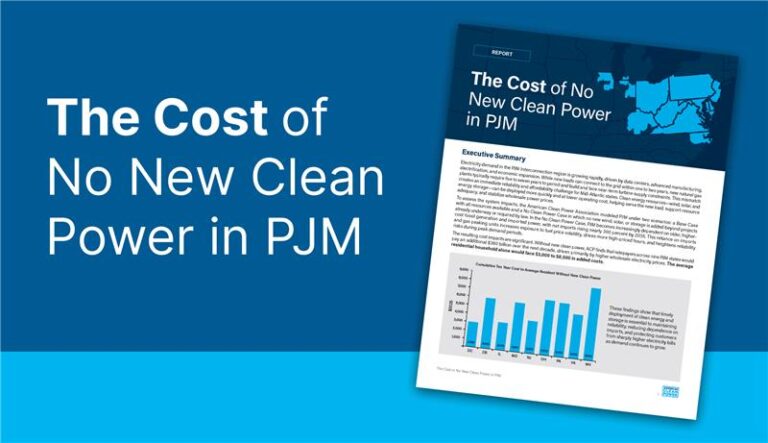
Electricity demand across the PJM Interconnection region is growing at an unprecedented pace, driven by rapid expansion of data centers, advanced manufacturing, electrification, and broader economic growth. A new analysis by ACP finds that without timely deployment of significant new clean energy resources, Mid-Atlantic and Midwest states face serious reliability risks and dramatically higher electricity costs over the next decade.
There is a growing mismatch between demand growth and new conventional generation that presents an immediate challenge to grid reliability and affordability across the PJM region. To evaluate system-wide impacts, ACP modeled PJM under two scenarios: a base case, where all generation resources are available, and a no clean power case, where no new wind, solar, or storage projects are added beyond those already under construction or required by law.
Key Data Points:
- Without new clean energy development, ACP estimates that ratepayers across nine PJM states would pay an additional $360 billion over the next ten years, driven primarily by higher wholesale electricity prices.
- The average residential household would see $3,000 to $8,500 in additional electricity costs over the next decade.
- In the “no new clean power” case, PJM becomes increasingly reliant on aging, higher-cost fossil fuel generation and imported electricity. Net power imports rise nearly 300% by 2035, increasing exposure to fuel price volatility and operating hours with extremely high electricity prices.
State Reports:
Download The Cost of No New Clean Power fact sheet for specific states from the list below.
Resource added March 23, 2026