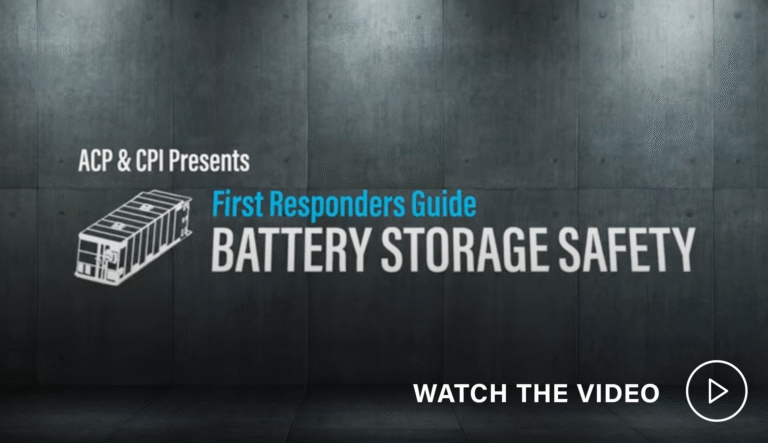
This short video is created specifically for firefighters, first responders, and community stakeholders to better understand the fundamentals of Battery energy storage systems (BESS) and their safety.
Energy storage is a critical resource to ensure our national electric grid can meet the growing energy demands of our economy. As communities across the country consider how to incorporate these significant infrastructure investments, the energy storage industry continues to focus on safety – listening to community concerns, integrating lessons learned from past incidents, and updating best practices. This includes understanding and utilizing the National Fire Protection Association’s Standard for the Installation of Stationary Energy Storage Systems (NFPA 855), the industry standard mandating fire safety and hazard mitigation requirements for energy storage systems.
In under 15 minutes, this video introduces important safety concepts to understand energy storage systems. National fire safety experts Paul Hayes, Mike Nicholas, Bobby Ruiz and Nick Warner outline critical concepts and address common questions asked by community stakeholders and first responders, including:
- What is a Battery Energy Storage System (BESS)?
- How should community first responders engage with project developers to understand energy storage systems before operations begin?
- What steps should be taken to address a safety incident at an energy storage facility?
- How does NFPA 855 guide project development and incident response decisions?
This video should not be reproduced or directly linked without the following disclaimer:
The First Responders Guide for Battery Storage Safety video and the information contained therein is for educational purposes only.
Users of this guide should not rely exclusively on the information contained therein and should apply sound business, scientific, engineering, legal and safety judgment in employing the information, or, as appropriate, seek the advice of a competent safety professional in determining the exercise of reasonable care or other actions to take or not take in any given set of circumstances. This guide is not a substitute for health and safety training.