REPORT: Clean Power Adds Record 50 GW in 2025 As Surging Electricity Demand Accelerates
Mar 5 2026
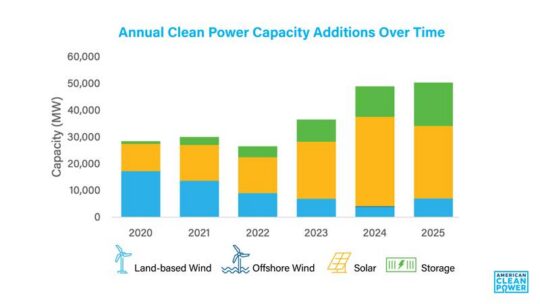
- U.S. clean power delivers 90% of all new capacity added to the grid in 2025 as developers plug in a record 50,344 MW.
- Energy storage installations jumped 41% year over year, exceeding 2024 levels by nearly 4 GW and marking another record-breaking year for batteries.
- Amid rising regulatory challenges, power purchase agreements (PPA) activity fell 27% while pipeline growth slowed to 1%.
WASHINGTON, D.C. March 5, 2026 – The American Clean Power Association (ACP) today released its Q4 2025 Clean Power Quarterly Market Report, showing the U.S. clean energy industry delivered its strongest year on record.
Developers brought 18.6 gigawatts (GW) of new utility-scale solar, wind, and energy storage online in Q4 alone — pushing the 2025 annual total to more than 50 GW. That’s enough electricity to power more than 6.9 million homes.
These three technologies accounted for 90.5% of all new power capacity in 2025 and over 80% of capacity additions over the previous five years, according to ACP and the U.S. Energy Information Administration. Battery storage led the charge, exceeding 2024 deployment by nearly 4 GW — a 41% year-over-year increase.
“This record year shows that our industry is resilient and delivers the reliable, affordable energy that Americans need,” said ACP Chief Policy Officer, JC Sandberg. “These numbers aren’t surprising given the consistent market and policy environment the industry enjoyed heading into 2025.”
While clean power remains one of the most affordable ways to build the power generation America needs, the medium-term outlook remains uncertain. The near-term pipeline rose to over 187.5 GW — but growth is slowing with only two GW added during the fourth quarter.
Decline in Power Purchase Agreements Raises Concern
Although installations hit record highs in Q4 of 2025, power purchase agreements (PPAs) — a key indicator of future growth — declined 27% year over year, which signals lower clean power deployment in 2028-2030. Despite rapidly growing electricity demand, many buyers delayed decisions in the second half of the year, awaiting clarity on federal policy and tax credit eligibility rules.
“Current policy instability is beginning to impact investor confidence and negatively affect project timelines at a time when demand is surging,” continued Sandberg. “With energy costs continuing to rise, limiting affordable clean energy generation deprives American families and businesses of needed relief. But it’s not too late. Stable policy that supports multi-tech energy development can help us maintain the incredible momentum that has brought us to this record year.”
Q4 2025 Market Report Findings
- Strongest Clean Power Year on Record: Total clean power capacity installed in 2025 reached 50,344 MW — a 3% increase over 2024 and the first-time annual deployment has surpassed 50 GW.
- Storage Surges: Energy storage installations were 41% higher than 2024 — the previous record year. The storage development pipeline continues to expand, growing 2% year-over-year, signaling sustained long-term demand.
- Medium-term Pipeline Outlook Increasingly Uncertain: The near-term pipeline rose to 187,514 MW. However, growth is slowing with only two GW added during the fourth quarter. A 27% year-over-year drop in PPA announcements is an early warning sign for lower clean power deployments in 2028-2030.
- Offshore Wind Under Pressure: No new offshore wind capacity came online in Q4, and the pipeline contracted following project cancellations. Continued federal and regulatory interference is creating additional headwinds for the sector.
- Value Proposition for States: Clean power is delivering low-cost power, jobs, and a boost to local economies across the U.S. — with projects operational in all 50 states. Nineteen states grew their clean power capacity by more than 20% in 2025, with Kentucky increasing its capacity by 188% to reach the Top 10 for 2025 solar installations. Increased adoption is set to continue: 35 states have more than 1 GW of clean power in the pipeline.
The full report and underlying datasets are available exclusively to ACP members.