Powering Through Extremes: How Clean Energy Lowers Costs and Improves Reliability
Extreme weather is not a rare disruption but is now an annual expectation.
Heat waves and winter storms are more frequent, more intense, and last longer. The western U.S. broke the record for the hottest March temperature in history at 108 degrees earlier this year. The eastern U.S. is expected to shatter records this July 4th weekend with temperatures reaching 115 degrees. And in January, Winter Storm Fern brought freezing rain, sleet, snow, and bitter cold across two-thirds of the country. Each of these events puts enormous strain on the power grid, and the way we generate electricity determines whether that strain becomes a crisis or a manageable challenge.
When temperatures surge past 100°F in Virginia or plunge below zero in Texas, electricity demand spikes dramatically. During a heat wave, nearly every home and business runs air conditioning and keeps it running around the clock. Whereas in winter storms electric heating demand surges at the exact same time that natural gas, which fuels most of our power plants, is being diverted to heat homes and buildings. Power plants end up competing for the same fuel that millions of families need to stay warm. To make up the difference, grid operators turn to older, less efficient plants burning expensive fossil fuels, driving wholesale electricity prices from as low as $30/MWh on a normal day to thousands of dollars during a grid emergency. When local generation still falls short, grid operators will import power from neighboring grids, but those neighbors can be struggling with the same event, limiting how much help they can actually provide.
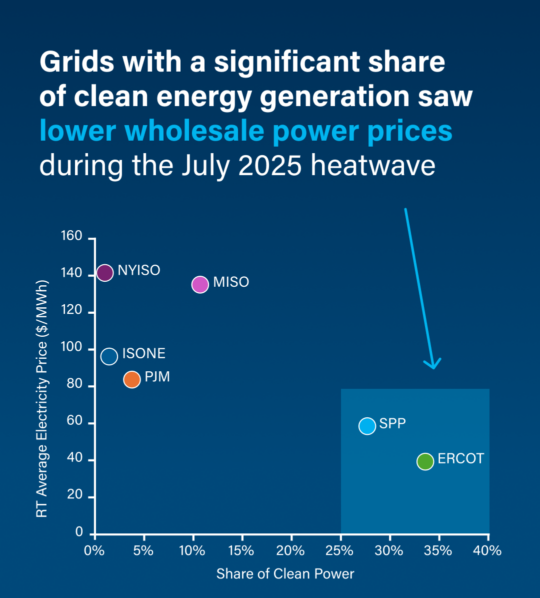
The evidence from recent extreme weather events is clear: grids that include meaningful amounts of clean energy resources perform better, cost less, and protect consumers more effectively. During a three-day heat wave in late July 2025 that tied and broke records across the Central and Eastern U.S., clean energy saved the grid more than $114 million. In Texas, a 34% share of renewables saved consumers $47 million. In the Great Plains, wind’s 28% share of generation saved over $26 million. During Winter Storm Fern in January 2026, clean energy saved the grid over $2 billion in operating costs and generated enough power for 43 million homes. Wind and solar in the Midwest alone, at just a 16% share, saved over $1 billion.
Why does clean power make such an economic difference? Because wind and solar have no fuel cost and no fuel supply chain to disrupt. When a gas pipeline freezes or fuel prices spike, solar panels and wind turbines keep generating as planned. A well-sited solar fleet naturally produces the most power during the hottest hours of a heat wave, directly offsetting the surge in air conditioning demand. Wind resources spread across multiple regions provide steady output day and night. Their role is to consistently meet energy needs such that electricity prices can stay stable and affordable.
Reliability and backup capacity is where battery storage comes in. Storage systems charge up during times of cheap surplus power and discharge precisely when demand peaks, replacing the costly fossil fuel peaker plants that drive up prices during emergencies. Together, wind, solar, and storage reduce dependence on gas-fired generation at the moments when gas is most constrained, lessen the price spikes that hit consumers hardest, and give grid operators the tools to keep the lights on without resorting to rolling blackouts.
As extreme weather grows more frequent and more severe, the stakes for getting our energy mix right keep rising. Clean power is a proven part of a lower-cost, resilient grid solution, and the data proves it.
ACP’s research team provides quantitative analysis to help better understand how the grid works and how clean power projects deliver the affordable, reliable energy America needs. A new ACP analysis uses July 2025 as a case study for how clean energy saves money during a heatwaves.