American Energy Manufacturing: Growth, Jobs, and Competitiveness
American energy infrastructure is revitalizing domestic manufacturing. Smart trade policy can help.
Even the most attentive supply chain expert may struggle to keep up with the many tariff announcements and complex sourcing dynamics affecting the American clean power industry over the past year. They continue to obstruct the power industry’s ability to meet growing energy demand and affordably serve customers. Yet a bright spot remains: the onshoring of the clean energy supply chain, a trend building since 2022.
Last year’s inaugural State of Clean Energy Manufacturing in America report found that federal energy incentives drove an immediate response to build in America. This year’s report finds that this momentum has continued, particularly in the downstream solar and storage supply chain, with 70 new manufacturing facilities coming online in the past year alone.
American Jobs Energizing Communities
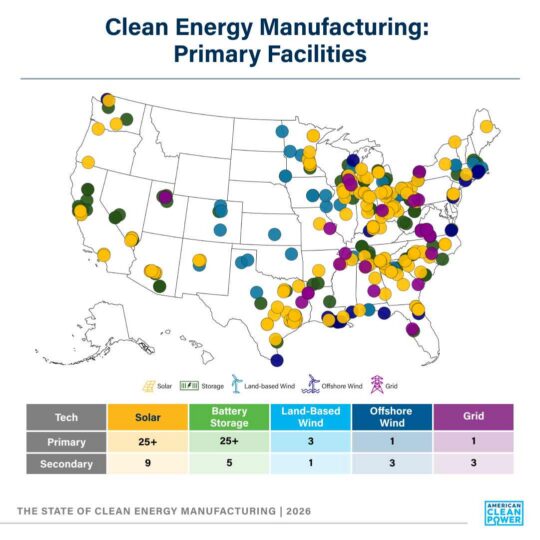
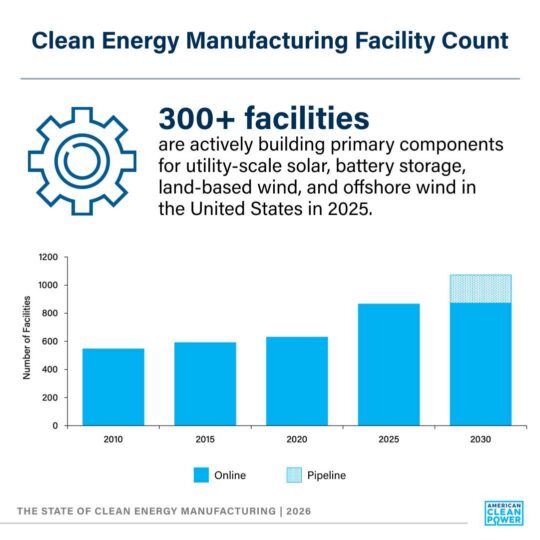
The U.S. now has over 825 facilities supporting the clean energy supply chain, directly employing 50,000+ Americans. But that’s just the start of the economic picture.
These facilities don’t operate in a vacuum, they pull in a vast network of suppliers providing everything from the steel and concrete in the ground to the bolts, screws, wires, and glass that go into each component. That demand drives additional work for trucking and shipping companies, accounting and law firms, and construction companies among others in the broader supply chain ecosystem.
And when workers at a wind tower facility in Colorado, a solar tracking line in Pennsylvania, or a lithium mine in Nevada bring home a paycheck, that money doesn’t stay in their pockets. It flows into their communities, supporting the grocery store cashier, the restaurant server, the gym owner, and the car dealer.
Add it all up, and the clean energy manufacturing sector supports over 215,000 jobs, $31B in GDP, and $61B in spending injected into the U.S. economy.
Building American Energy Dominance
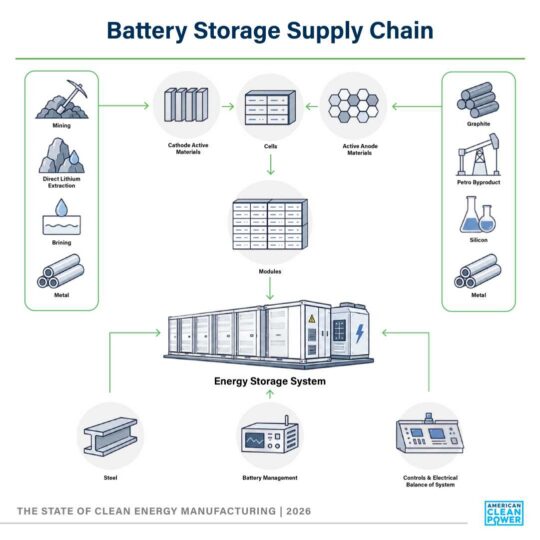
2025 marked a new milestone: the U.S. now has the production capability to manufacture and assemble all types of downstream components domestically across technologies. This includes modules for both solar and storage (effectively the wiring and assembly of energy cells), wind nacelles, and wind turbine towers.
This full downstream capability is essential for upstream supply chain development. It creates the economic conditions to incentivize upstream production so that U.S. manufacturers can start to produce more: crystalline silicon cells, ingots, wafers, and polysilicon for solar and more cells, anode and cathode active materials, graphite, and lithium for battery storage.
ACP’s data shows that most of the critical battery storage supply chain could be domestically supplied by the end of the decade, based on facilities currently under construction and announced investments. America is on track to exceed 950+ facilities across technologies by 2030, bringing new projects and new opportunities to communities while establishing a stable, long-term workforce.
Trade Policies to Protect American Industry
But that trajectory depends on sensible trade policies that support and do not undermine supply chains. Clean energy manufacturing is booming thanks to two reinforcing drivers – first, broad deployment of solar, wind, and storage across the country, and second, federal incentives that reward onshoring. Undermining clean power through inefficient federal action, including unclear tariff and trade policies, curbs demand and thus stands in the way of one of the clearest success stories in the American manufacturing renaissance.
Broad tariff action across an entire supply chain can carry unintended consequences. Onshoring works by starting downstream and building upstream. Tariffing the upstream components while the downstream facilities that rely on them are still maturing undermines the very factories American has invested in – and benefitted from.
The result is a lose-lose: either we can’t build sufficient generation capacity to meet rising electricity demand and forfeit the economic gains of an electrifying economy, or we can meet load – but at unnecessarily higher costs to customers.
Onshoring the clean energy supply chain is central to U.S. competitiveness and energy security. The data is clear: it can be done, but it requires smart, consistent support and investment that protects both American industry and electricity customers.
ACP’s second annual State of Clean Energy Manufacturing Report provides deep insights on how domestic clean energy manufacturing is powering America’s economic prosperity, generating revenue, supporting jobs, and strengthening energy independence.